
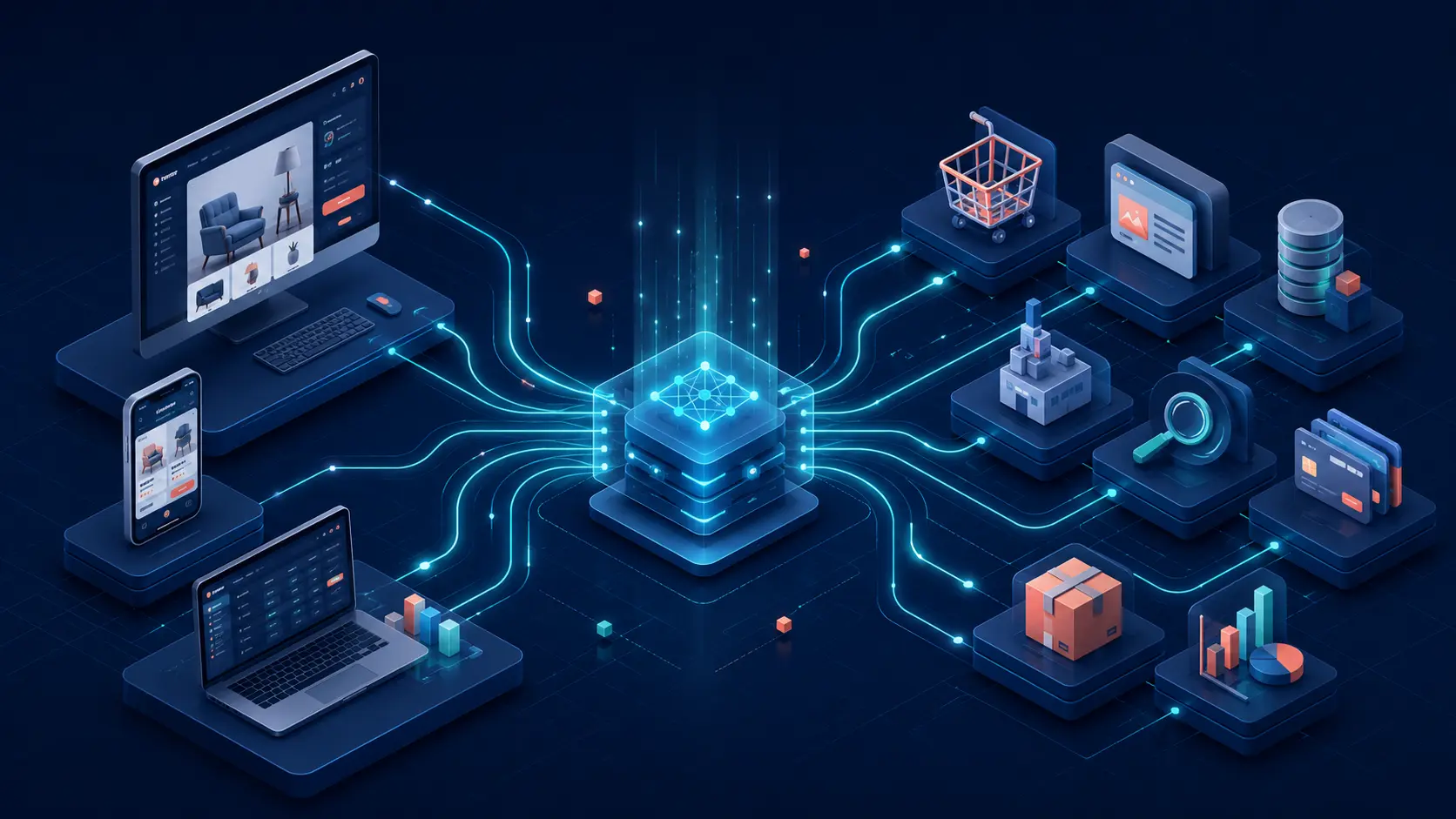
The most useful way to understand headless ecommerce is not to imagine one platform with its theme removed. Think of it as a working agreement between independent systems. Each system owns a clear job, and APIs keep product information, prices, content, carts, payments and orders moving between them.
Decoupled commerce architecture separates an ecommerce website’s frontend presentation layer from its backend commerce engine. The two layers communicate through APIs, allowing a business to change customer experiences without replacing the systems responsible for products, orders, payments or inventory.
That freedom can be valuable. A retailer can redesign its storefront, launch a mobile app or build a dealer portal while keeping a trusted commerce platform and ERP. The tradeoff is equally real: the business now owns more integrations, more monitoring and more decisions about where each piece of data should live.
| Architecture | How the frontend connects | Flexibility | Technical responsibility | Typical fit |
|---|---|---|---|---|
| Traditional commerce | Frontend and backend are delivered together | Limited to moderate | Lower | Simple stores and fast launches |
| Decoupled commerce | Separate experience connected through APIs | High | Medium to high | Growing stores with custom journeys |
| Headless commerce | Fully independent experience layer | Very high | High | Omnichannel and complex commerce |
| Composable commerce | Independent business capabilities connected together | Highest | Very high | Large ecosystems with strong platform teams |
How Decoupled Commerce Architecture Works
A shopper does not see the architecture. They see a product page, stock status, price and checkout. Behind that page, the frontend may be collecting information from several services before assembling the final experience.
When a visitor opens a category page, the frontend requests product records from the commerce engine or PIM. Editorial copy and campaign blocks come from the CMS. A search service supplies ranking and filters. The ERP may return regional stock or contract pricing. At checkout, payment, tax, fraud and order services complete their own parts of the transaction.
A Practical Decoupled Commerce Data Flow
The API and orchestration layer prevents every customer channel from building a separate direct integration to every backend system.
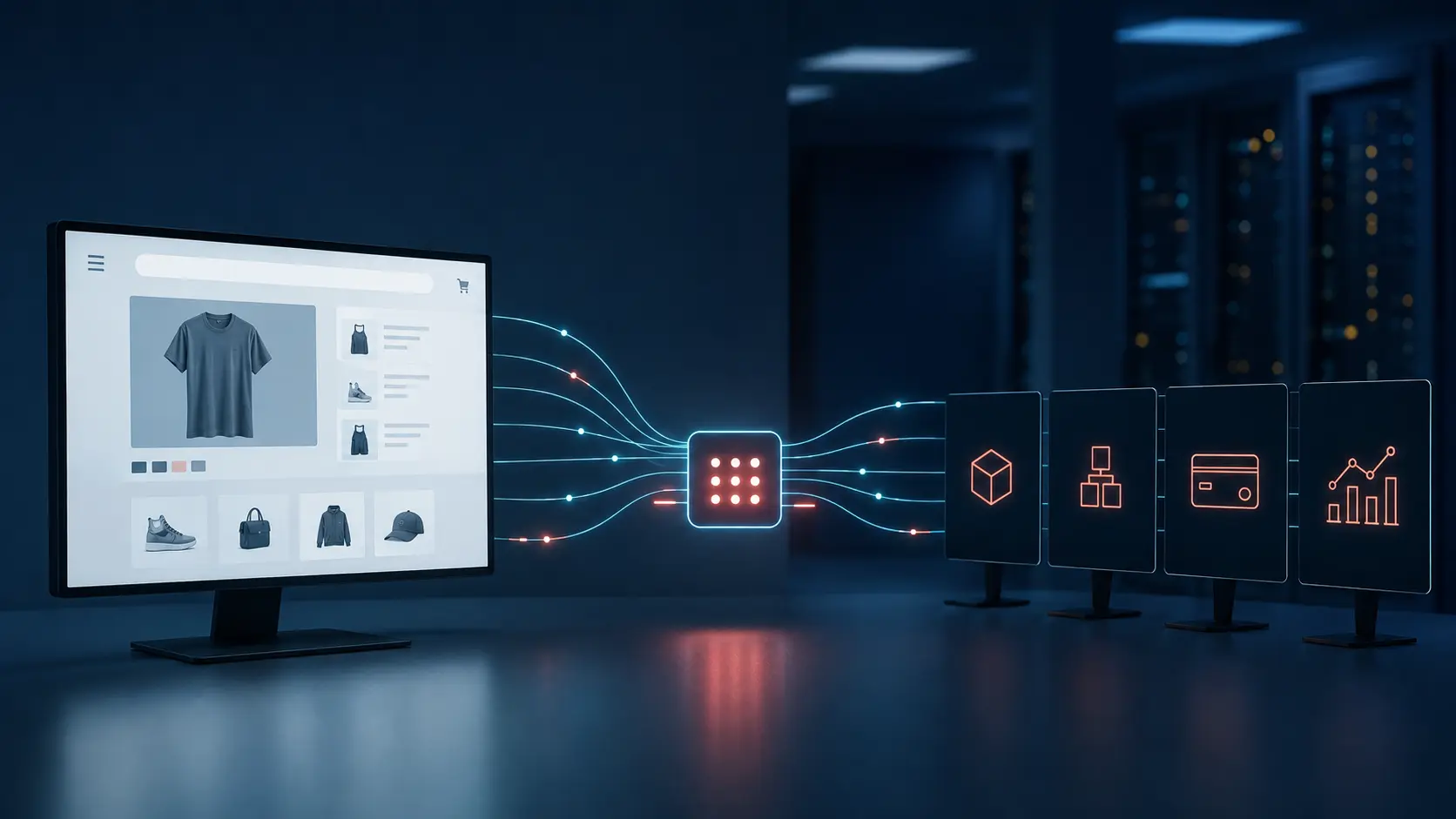
A typical request moves through eight steps:
- The customer opens a channel such as a website, app or portal.
- The frontend requests content and commerce data through an API or backend-for-frontend layer.
- The CMS returns page content and reusable campaign blocks.
- The commerce engine or PIM supplies product data, pricing rules and variants.
- Search and personalization services decide which products to show and in what order.
- Inventory and ERP services confirm availability, account terms or fulfilment options.
- The checkout connects to payment, tax, fraud and order services.
- The frontend presents the result as one continuous customer experience.
The Components That Make the Architecture Work
There is no universal headless tech stack. The right boundaries depend on the business. Still, most production systems contain the following capabilities.
Frontend Experience Layer
The customer-facing website, mobile app, progressive web application, kiosk or portal. Teams commonly use React, Next.js, Vue, Nuxt or another modern framework, but the framework matters less than the rendering, caching and operational plan.
Commerce Engine
The system that owns catalogue rules, carts, promotions, pricing, customer accounts, checkout logic and orders. Some projects keep one large commerce backend; others split capabilities into services.
API and Orchestration Layer
REST, GraphQL, webhooks, middleware and API gateways move data between systems. A backend-for-frontend can combine several responses so the storefront does not need to understand every internal service.
Headless CMS for Ecommerce
The CMS manages landing pages, guides, banners, localization and reusable content blocks. Editors need preview, scheduling and governance that work with the custom frontend, not only an API endpoint.
Headless PIM
A product information management system centralizes names, descriptions, specifications, images, variants, categories, translations and channel-specific product attributes. It reduces the temptation to maintain the same product record in several places.
ERP and Operational Data
The ERP may provide inventory, contract pricing, finance, warehouse information, procurement and order status. “Headless ERP” usually means an API-connected ERP in a headless system, not a separate architectural category.
Search and Merchandising
Specialist search services handle queries, filters, synonyms, ranking, recommendations and merchandising rules. They must receive product updates reliably and return results quickly enough for the storefront.
Headless Checkout and Payments
Checkout can be platform-hosted, embedded or custom. A custom checkout offers control but increases testing, accessibility, fraud and compliance responsibilities. Payment data should be handled through an appropriate provider and carefully scoped security design.
Decoupled, Headless, Traditional and Composable Commerce
If you are still deciding between referral, supplier-fulfilled and inventory-owned selling, begin with our ghost commerce, affiliate marketing and dropshipping comparison. It clarifies who owns the checkout, customer relationship and fulfilment risk before architecture becomes the question.
Are Decoupled and Headless Commerce the Same?
They describe closely related ideas, and vendors often use the terms interchangeably. Both separate presentation from commerce logic. The technical distinction is that a decoupled platform may still offer an optional predefined frontend, while a headless implementation assumes the frontend is completely independent.
In practice, the more important question is not which label a vendor uses. Ask how much of the experience can be replaced, which APIs expose core commerce functions, where checkout runs and what dependencies remain on the original presentation layer.
| Decision area | Traditional ecommerce | Decoupled or headless ecommerce |
|---|---|---|
| Storefront changes | Bound to platform themes and release patterns | Built and deployed independently |
| Launch speed | Usually faster for a standard store | Longer when integrations and custom journeys are involved |
| Customization | Limited by platform extension points | High control over experience and channels |
| Operations | One vendor often owns more of the stack | The business coordinates several services and vendors |
| Initial cost | Usually lower | Usually higher due to design, development and integration |
| Long-term flexibility | Depends heavily on the platform | Higher when system boundaries are designed well |
How Composable Commerce Goes Further
Headless separates the customer experience from the commerce backend. Composable commerce separates individual business capabilities. A composable stack may use one service for search, another for promotions, another for cart and checkout, plus separate CMS, PIM and order management systems.
This can reduce dependence on one vendor and let teams improve a capability without replacing the whole platform. It can also turn a single vendor contract into a portfolio of integrations, service-level agreements and release schedules. The MACH Alliance uses microservices, API-first, cloud-native SaaS and headless as the core ideas behind this modular model.
Benefits of Headless Commerce and the Limits Behind Them
Greater Frontend Freedom
Designers and developers are not limited to a commerce theme. They can shape navigation, product discovery and account experiences around the customer.
Independent Experience Releases
A frontend team can improve interfaces without changing core order logic. This can shorten release cycles after the architecture and delivery pipeline are stable.
Omnichannel Delivery
One commerce backend can support a website, mobile app, customer portal, marketplace integration and in-store experience.
Stronger Content and Commerce
A headless CMS gives editorial teams reusable content models and richer storytelling without forcing commerce data into the CMS.
Selective Platform Evolution
Well-defined interfaces make it possible to replace search, CMS or another capability without rebuilding the entire ecosystem.
B2B Personalization
The experience can combine account catalogues, contract prices, approvals and regional content into a portal designed for a specific buyer.
Performance is often listed as a benefit, but it needs careful wording. Headless architecture can support server rendering, edge caching and smaller customer-facing payloads. It can also create slow pages if every request waits for several APIs, if caching is weak or if the frontend ships too much JavaScript. Architecture creates options; implementation determines speed.
The Challenges Teams Underestimate
- Higher implementation and ongoing engineering cost
- Multiple vendors, contracts and release schedules
- API latency, rate limits and failure handling
- Content preview and publishing workflow gaps
- More integration, regression and end-to-end testing
- Security, identity and payment responsibilities
- Distributed monitoring and incident diagnosis
- Specialist frontend and platform engineering needs
The PCI Security Standards Council’s ecommerce guidance is a useful reminder that custom payment pages require explicit controls against script tampering and e-skimming. Moving to headless does not make the checkout risk disappear.
Building a Headless Commerce Technology Stack
Start with business capabilities, not a vendor shopping list. Decide which system is authoritative for each important data object, then document the APIs, events, fallbacks and owners that connect them.
| Layer | Primary purpose | Questions to resolve |
|---|---|---|
| Frontend | Customer experience and rendering | Who owns releases, hosting, accessibility and performance? |
| CMS | Editorial content and localization | Can editors preview, schedule and reuse content? |
| Commerce engine | Cart, pricing, promotions and orders | Which functions are API-accessible and rate-limited? |
| PIM | Product information and assets | Where is product truth maintained and validated? |
| ERP | Inventory, finance and fulfilment | Is data real-time, cached or synchronized in batches? |
| Search | Discovery, filtering and merchandising | How quickly are product and inventory changes indexed? |
| Payments | Transactions, tokenization and fraud controls | Which party owns PCI scope and payment-page security? |
| Middleware | Integration, orchestration and transformation | How are retries, queues, failures and observability handled? |
| Analytics | Customer and commercial measurement | How are events kept consistent across channels? |
A platform-agnostic ecommerce architecture sounds attractive because it reduces dependence on one supplier. In reality, independence comes from disciplined contracts between systems, portable data, tested integrations and operational documentation. A stack built from replaceable vendors can still become difficult to change if business logic leaks into every connector.
Decoupled Commerce for B2B and Complex Use Cases
B2B commerce is often a strong fit because the buying experience must combine customer-specific information from several systems. A signed-in buyer may need a private catalogue, contract prices, volume rules, quotes, credit limits, approval workflows, reorder tools and shipment status.
International Ecommerce
Support regional catalogues, languages, currencies, tax rules and local content while sharing appropriate backend capabilities.
Multi-Brand Commerce
Operate distinct storefronts and brand experiences over shared product, inventory and order systems.
B2B Customer Portals
Combine pricing, quotes, account documents, reordering and order tracking into a role-based experience.
Content-Led Retail
Blend buying guides, editorial stories, product education and interactive tools with live commerce data.
Omnichannel Retail
Connect websites, apps, kiosks and assisted-selling tools to consistent product and customer services.
Legacy Modernization
Introduce a new experience layer while keeping an ERP or commerce system that remains operationally valuable.
A Migration Roadmap That Controls Risk
A headless migration should not begin with a framework selection. Begin with the customer journey that the current platform cannot support and the measurable outcome the new architecture is expected to improve.

Define Requirements and Outcomes
Map journeys, channels, markets, integrations, content workflows, performance targets, security needs and commercial KPIs.
Draw System Boundaries
Decide what remains, what changes and which system owns product, price, content, customer, inventory and order data.
Select Platforms Against Real Use Cases
Test API coverage, documentation, limits, security, B2B functions, ecosystem maturity, support and total operating cost.
Prototype One Complete Journey
Build a narrow vertical slice such as product discovery through checkout. Include content editing, analytics and failure handling.
Integrate and Test
Validate function, accessibility, SEO, performance, security, mobile behaviour, checkout and recovery when dependencies fail.
Launch with Observability
Monitor API response time, errors, conversion, checkout failures, inventory accuracy, publishing and system availability.
When Decoupled Commerce Is the Wrong Choice
Choose the simplest architecture that supports the business. A traditional platform is often better when one storefront serves a straightforward catalogue, standard themes meet customer needs, integrations are minimal, developer capacity is limited or the expected commercial benefit is unclear.
How to Select a Decoupled Commerce Platform
Vendor demonstrations usually show the happy path. The checklist below focuses on what the operating team will need after launch.
Headless Commerce Platform Selection Checklist
- Stable, documented and versioned APIs
- Required B2B or B2C business functions
- Clear ERP, PIM, CMS and payment integrations
- Support for every required market and channel
- Editor preview, scheduling and localization
- Authentication, privacy and compliance controls
- API limits that match peak traffic
- Monitoring, logs and practical error handling
- Reliable webhooks and event delivery
- Mature developer tools and partner ecosystem
- Understood implementation and operating cost
- Data portability and component replacement path
Ask each shortlisted vendor to demonstrate the same critical journey with your data shape. Include a failed inventory call, expired session, promotion conflict and content rollback. A platform is not proven by its best demo. It is proven by how predictably the team can operate it when normal dependencies behave imperfectly.
Frequently Asked Questions
What is decoupled commerce architecture?
It is an ecommerce architecture that separates the customer-facing experience from the backend commerce engine. APIs connect the storefront with products, carts, checkout, orders, content, inventory and other business systems.
What is the difference between decoupled and headless commerce?
Both separate frontend presentation from backend commerce. A decoupled platform may retain an optional supplied frontend. A headless platform normally assumes the experience layer will be built and operated independently.
How does headless commerce architecture work?
The storefront requests data and actions through APIs. A commerce engine handles commerce logic, while a CMS, PIM, ERP, search service, payment provider and analytics platform contribute their own data or capability.
Does headless commerce require a headless CMS?
No. A headless storefront can work without a separate CMS, but content-rich businesses often use one so editorial teams can manage reusable content independently from product and order systems.
What is a headless PIM?
The phrase usually describes a product information management system that exposes product data through APIs for use by independent storefronts and channels.
What is headless checkout?
Headless checkout separates the checkout experience from the main commerce presentation layer. It may be hosted by the platform, embedded in a custom storefront or built from composable payment and order services.
Is headless commerce faster than traditional ecommerce?
It can be, but speed is not automatic. Rendering strategy, API latency, caching, images, scripts and implementation quality determine real performance.
Is headless commerce suitable for B2B businesses?
Yes, especially when a business needs account pricing, complex catalogues, approval workflows, ERP data and customer portals. It still requires sufficient integration and operational capability.
What are the disadvantages of decoupled commerce?
The main disadvantages are higher cost, more integrations, a larger testing surface, distributed monitoring, vendor coordination and the need for specialist technical skills.
How much does headless commerce development cost?
There is no responsible fixed figure without a scope. Cost depends on the number of channels, integrations, custom journeys, migration volume, security requirements, team model, hosting and ongoing support. Estimate the full operating model, not only the storefront build.
The Architecture Should Earn Its Complexity
Decoupled ecommerce gives a business room to design channels around customers instead of around one platform theme. APIs connect the experience layer to commerce, content, product, operational and payment systems. That can be valuable for B2B portals, international stores, multi-brand groups, content-led retail and omnichannel journeys.
The same separation creates more responsibility. Someone must own integrations, observability, security, testing and the customer experience when a dependency slows down or fails. The right decision is therefore commercial before it is technical.
Before selecting a headless platform, document the customer journeys, business systems, integration requirements, internal capabilities and measurable outcomes the new architecture must support. If that work does not reveal a meaningful limitation in the current platform, a simpler architecture may still be the better investment.
Continue with Cresto Digital
Planning a Headless Commerce Build or Migration?
Cresto Digital can review the architecture from an SEO, content, performance and measurement perspective before expensive implementation decisions become difficult to reverse.
Discuss your ecommerce architecture →