Google Algorithm Updates 2026: Complete Timeline, August Spam Update and What Changed for SEO
A complete guide to every major confirmed Google update in 2026, including core updates, spam updates, AI Search changes, content policies, structured-data changes and what they mean for your SEO strategy.
Overview of Google algorithm updates in 2026 and their impact on SEO.
Google Search has changed significantly in 2026. From core updates and spam updates to AI Search guidance and content-policy changes, there is a lot for SEOs and website owners to track. The important point is that 2026 is not one single Google update. It is a sequence of ranking rollouts, spam-system improvements, Search feature changes and policy clarifications.
Google Algorithm Updates in 2026: Complete Timeline
The following timeline covers the major publicly confirmed Google Search rollouts through August 2026. Google also makes smaller changes continuously, so not every ranking movement maps to a named update.
| Update | Start Date | Completed | Main Scope |
|---|---|---|---|
| February 2026 Discover Core Update | Feb 5, 2026 | Feb 27, 2026 | Google Discover |
| March 2026 Spam Update | Mar 24, 2026 | Mar 25, 2026 | Global, all languages |
| March 2026 Core Update | Mar 27, 2026 | Apr 8, 2026 | Broad Search ranking systems |
| May 2026 Core Update | May 21, 2026 | Jun 2, 2026 | Broad Search ranking systems |
| June 2026 Spam Update | Jun 24, 2026 | Jun 26, 2026 | Global, all languages |
| August 2026 Spam Update | Aug 18, 2026 | Aug 21, 2026 | Global, all languages |
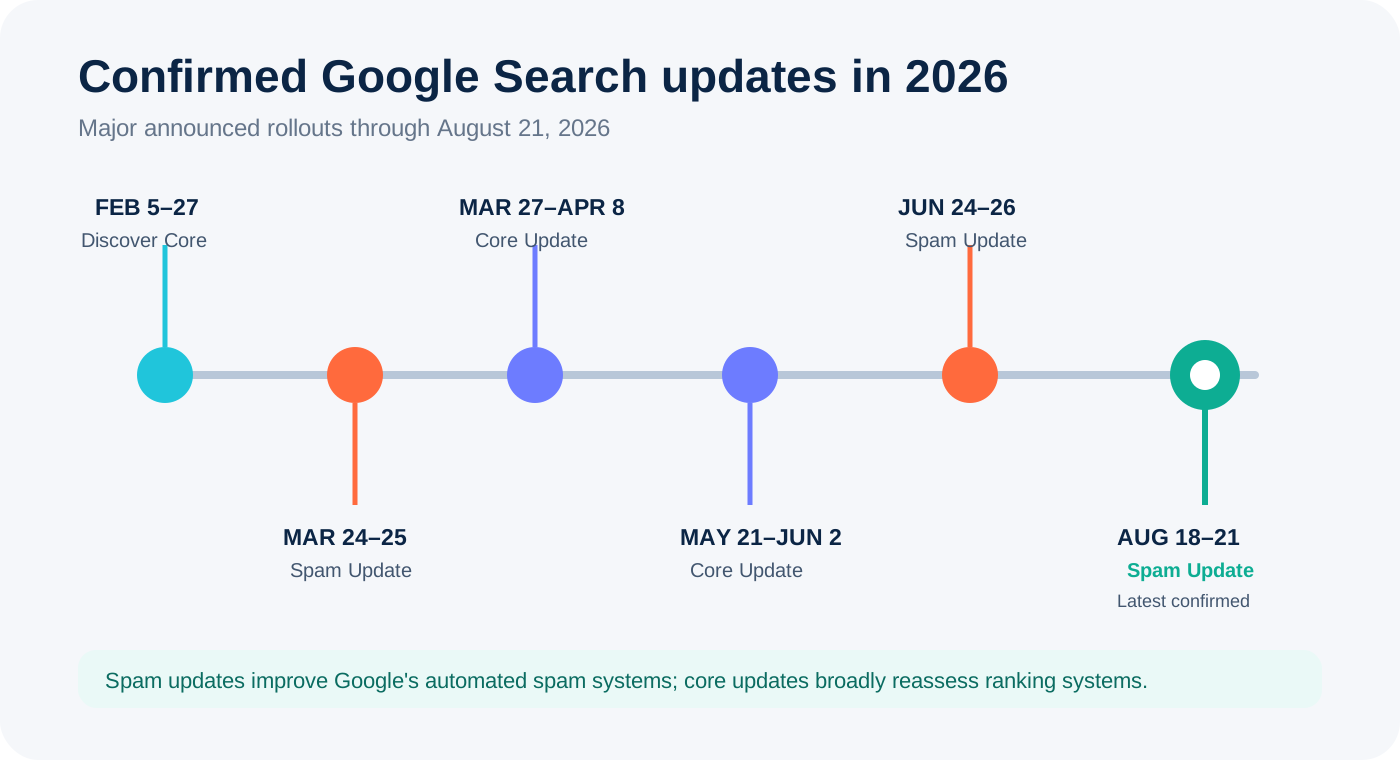
Confirmed major Google Search rollout windows through August 21, 2026.
February 2026 Discover Core Update
The first major announced ranking-related change of the year focused on Google Discover rather than normal blue-link Search results. Google said the update was designed to show more locally relevant content, reduce sensational or clickbait material, and surface more original, timely and in-depth content from sites that demonstrate expertise in a topic.
One useful clarification was that a website does not have to publish about only one subject to demonstrate expertise. Google's systems can understand expertise at a more specific topic level. That matters for large publishers and brands that cover several legitimate areas.
March 2026 Spam Update
Google launched the first spam update of 2026 on March 24. It finished in less than a day and applied globally across all languages.
Google did not introduce a new spam-policy category alongside this rollout. That distinction matters because it means we should not invent a March-specific target and present it as fact. A normal spam update represents improvements to Google's existing automated spam-detection systems.
Google has publicly described SpamBrain as an AI-based spam-prevention system. Spam systems operate continuously, while announced spam updates represent notable improvements to those systems.
March 2026 Core Update
Only a few days after the March spam update, Google launched the March 2026 Core Update. It ran from March 27 through April 8.
A core update is fundamentally different from a spam update. Core updates broadly recalibrate how Google evaluates and ranks information. A legitimate website can lose rankings during a core update without violating a spam policy.
Core Update
Broad ranking-system changes. Diagnose relevance, usefulness, intent fit, competition, freshness and overall quality.
Spam Update
Improvements to systems that detect spam-policy violations. Start by reviewing compliance and risky publishing patterns.
If a page loses during a core update, the right questions are comparative: Did stronger competitors appear? Did the SERP intent shift? Does another result answer the question more directly? Does your page provide enough first-hand knowledge, evidence and context?
Important 2026 Policy and Search Feature Changes
Back Button Hijacking Became an Explicit Spam Violation
In April, Google explicitly added back button hijacking to its malicious-practices documentation. This refers to interfering with normal browser history so visitors cannot simply return to the page they came from. Websites using deceptive navigation to create extra pageviews, ad impressions or redirects should treat this as a direct spam-policy risk.
FAQ Rich Results Were Retired
Google stopped showing the old FAQ rich-result treatment in May 2026 and later removed the corresponding documentation. This does not mean FAQ content itself is useless. Helpful FAQs can still answer objections, improve topical coverage and support conversions. What changed is the expectation that FAQPage markup will produce expandable FAQ results in Google Search.
Review Snippet Guidance Became Stricter
Google also tightened guidance around fake reviews and undisclosed incentivized reviews. Structured data does not make misleading review content acceptable. The underlying review still needs to be genuine and appropriately disclosed.
May 2026 Core Update
Google's second broad core update of the year began on May 21 and completed on June 2. As usual, Google did not provide a list of individual ranking-factor adjustments.
That means statements such as “Google reduced backlinks,” “Google increased content length,” or “Google penalized AI articles” should be treated as hypotheses unless supported by strong evidence. A core update usually affects multiple systems, and different site types can move for different reasons.
Google's 2026 AI Search Guidance: What Changed for SEO
One of the most important SEO developments in 2026 was Google's clearer guidance for AI Overviews and AI Mode. The overall message is that traditional SEO fundamentals still matter.
Pages still need to be crawlable, indexable, understandable, useful and relevant. Google's generative Search experiences use existing Search ranking and quality systems and can retrieve information from the Search index.
Query Fan-Out Became an Important Concept
Google's AI Search documentation describes query fan-out, where an AI system can generate several related searches to gather the information needed for a broader answer.
For example, a user asking for the “best laptop for an SEO consultant” might cause the system to explore battery life, portability, processing power, display quality, pricing and comparisons. This increases the value of complete semantic coverage and clearly structured information.
It does not mean you should create hundreds of thin pages for every possible fan-out query. That can create exactly the type of repetitive, low-value footprint Google is trying to reduce.
Non-Commodity Content Is Becoming More Important
Google's AI Search guidance emphasizes content that contributes something distinctive. In practical SEO terms, the advantage increasingly comes from information another publisher cannot reproduce instantly.
Examples include first-hand experience, original research, proprietary data, testing, expert commentary, real customer questions, useful screenshots, original photography, product comparisons based on actual use, and a genuinely different interpretation of a topic.
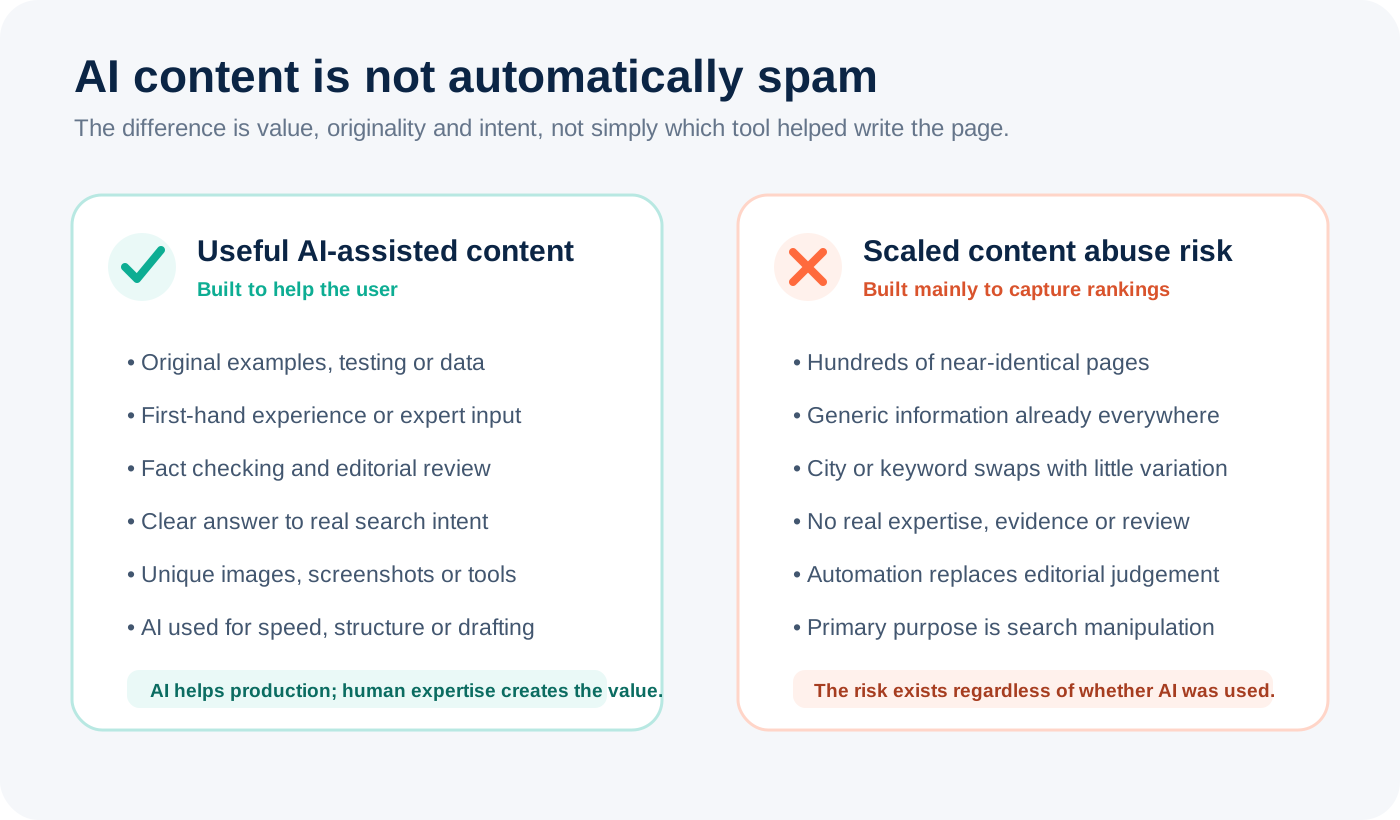
Google's spam policies focus on scaled low-value publishing, not simply whether AI helped write the text.
Does Google Target AI-Generated Content?
Google does not say that AI-generated content is automatically spam. The more relevant policy is scaled content abuse, which focuses on creating large amounts of unoriginal or low-value content primarily to manipulate rankings.
Generative AI can be one method used to create that content, but the policy applies regardless of whether the pages were written by AI, humans, scraping tools or another automated process.
Higher-Risk Pattern
- Hundreds of keyword variations
- Near-identical page templates
- Generic summaries of existing SERPs
- No original examples or evidence
- Publishing mainly to acquire rankings
Stronger Pattern
- Real user/search research
- Expert contribution
- Original screenshots or data
- Fact checking and editorial review
- A clear reason the page deserves to exist
What About Claude or ChatGPT Watermarks?
There is currently no reliable public evidence showing that Google Search uses a Claude-specific or ChatGPT-specific text watermark as a direct indexing or ranking signal.
That does not prove Google has no undisclosed AI-generation classifiers. Google does not publish every component of its ranking and spam systems. But there is a big difference between saying “Google may use undisclosed signals” and claiming “Google reads a Claude watermark and instantly rejects the page.” The second claim is currently speculation.
June 2026 Spam Update
The second spam update of 2026 began on June 24 and completed on June 26. Like the March and August rollouts, it applied globally and across all languages.
Again, Google did not announce a special new spam category for the rollout. This is why post-update analysis should separate confirmed Google statements from industry theories.
June 2026: Google Clarified Its Position on Llms.txt
The llms.txt format became popular as website owners looked for ways to make content easier for AI systems to understand. Google clarified in 2026 that llms.txt is not required for Google Search and does not positively or negatively affect Google Search rankings or visibility.
That does not necessarily mean another AI platform could never use the format. It means website owners should not treat llms.txt as a ranking shortcut for Google Search, AI Overviews or AI Mode.
August 2026 Spam Update: What We Know
The latest confirmed Google ranking update is the August 2026 Spam Update. Google started the rollout on August 18, 2026 and marked it complete on August 21, 2026.
Google confirmed that it applied globally and across all languages. It was the third announced spam update in roughly five months, following the March and June updates.
Google Did Not Announce a New Spam Category
Google did not publish a companion policy introducing a new August-only target. Therefore claims that the update specifically targets AI articles, Claude watermarks, ChatGPT output, one backlink type or any single hidden factor should not be presented as confirmed facts.
What Spam Practices Should Sites Review?
If visibility dropped during a spam update, review Google's existing spam policies rather than searching for one secret “August factor.” Important areas include scaled content abuse, expired domain abuse, site reputation abuse, doorway pages, scraped content, cloaking, hidden text, misleading functionality and manipulative link patterns.
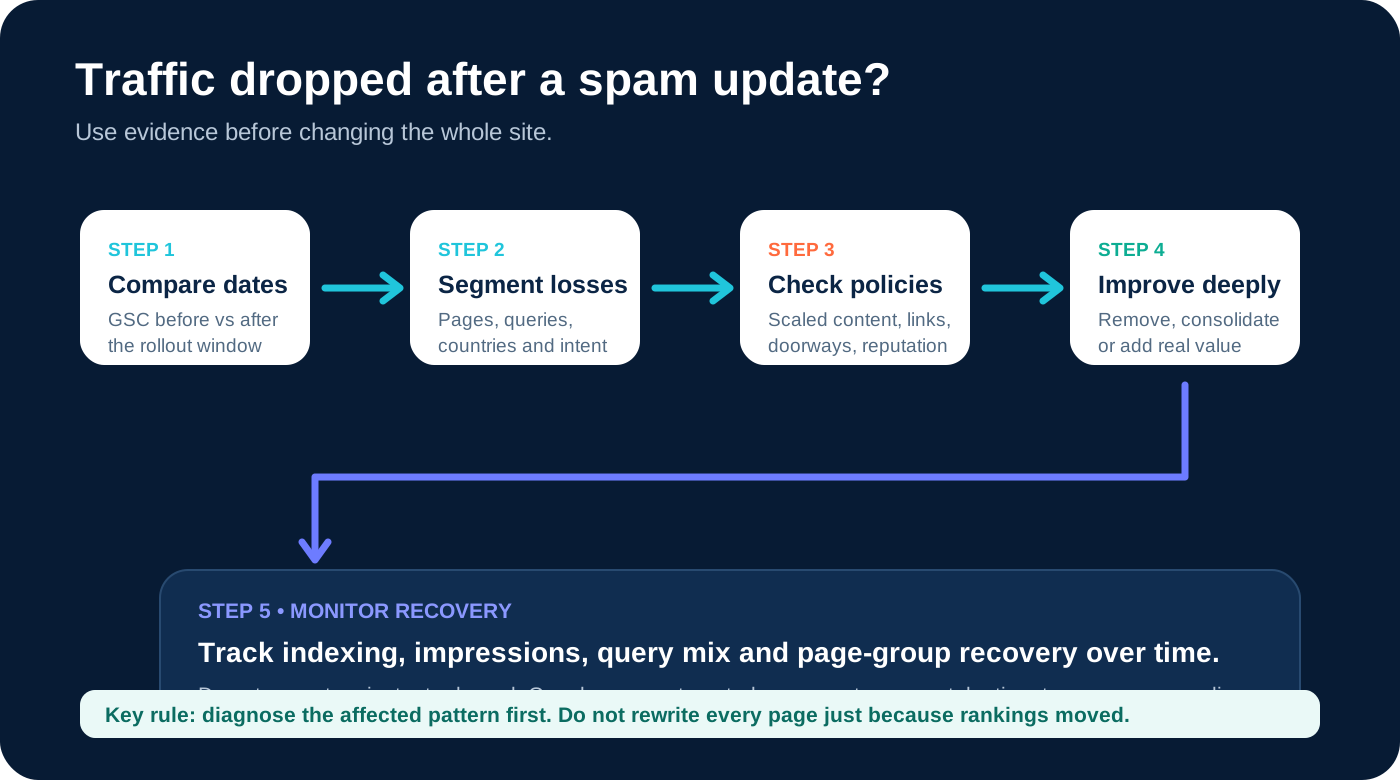
Start with Search Console evidence and affected page groups before deciding what caused a loss.
What Should You Do After the August 2026 Spam Update?
The first step is timing. Compare Search Console performance before August 18 with the period after August 21. Do not automatically attribute volatility from earlier in August to this rollout.
- Segment the decline. Look at page type, directory, query intent, country, device and content template.
- Identify clusters. If informational articles dropped while service pages stayed stable, the problem may be concentrated in one content group.
- Review spam-policy exposure. Examine scaled content, doorway strategies, expired-domain use, site reputation abuse and manipulative link practices.
- Compare against winners. Study what the new top-ranking pages provide that your pages do not.
- Improve or remove weak content. Cosmetic paraphrasing is rarely enough if the original page had little reason to exist.
- Add real information gain. Use first-hand evidence, original examples, data, expert input, screenshots and more useful explanations.
- Allow time for reassessment. Spam-system recovery may take time after a site consistently returns to compliance.
Core Update Recovery vs Spam Update Recovery
If You Dropped in a Core Update
- Review intent and relevance
- Compare stronger competitors
- Improve originality and usefulness
- Check site structure and user experience
- Avoid assuming a penalty
If You Dropped in a Spam Update
- Audit spam-policy compliance
- Find scaled or repetitive page groups
- Review link and reputation-abuse risk
- Remove or substantially rebuild weak pages
- Expect recovery to require reassessment
What Google's 2026 Updates Tell Us About SEO Direction
When the year's changes are viewed together, Google's direction becomes clearer. Discover emphasized original and topic-expert content. AI Search guidance emphasized non-commodity information. Spam policies focus on scaled low-value publishing regardless of how it was created. FAQ rich results were retired. llms.txt was clarified as unnecessary for Google Search visibility. And Google launched three spam updates between March and August.
The broader lesson is simple: publishing more pages is not the same as building more search visibility. The competitive advantage increasingly comes from producing information that deserves to be retrieved, cited, ranked and trusted.
What SEO Teams Should Prioritize Now
AI should not be removed from the workflow. It can still make research, analysis, outlining, editing and content operations more efficient. The important question is what the business adds after AI has done the easy part.
- Original research or internal data
- First-hand experience
- Expert commentary
- Actual customer questions
- Real screenshots, demonstrations and workflows
- Product or service testing
- Case studies with context and limitations
- Useful proprietary tools or calculators
- A clearly differentiated point of view
Frequently Asked Questions
What is the latest Google algorithm update in 2026?
The latest confirmed ranking rollout is the August 2026 Spam Update. It started on August 18 and completed on August 21, 2026. Google said it applied globally and across all languages.
How many Google spam updates have there been in 2026?
As of August 22, Google has confirmed three spam updates in 2026: March, June and August.
How many broad core updates has Google released in 2026?
Google has confirmed two broad Search core updates so far: March and May. February also included a separate Discover Core Update.
Does Google penalize AI-generated content?
Google does not classify content as spam simply because AI helped create it. Generating large quantities of unoriginal or low-value pages primarily to manipulate rankings can violate the scaled content abuse policy.
Did the August 2026 spam update target AI content?
Google has not announced AI-generated content as a specific August target. Existing spam policies already cover abusive automated publishing.
Does Google detect Claude or ChatGPT watermarks?
There is no reliable public evidence showing that Google Search uses a Claude- or ChatGPT-specific text watermark as a direct indexing or ranking signal.
Does llms.txt improve Google AI Overview or AI Mode visibility?
Google has said llms.txt is not required for Google Search and does not positively or negatively affect Search rankings or visibility.
Can a site recover from a spam update?
Yes. Fix the underlying policy or quality problems and maintain compliance. Automated systems may take time to reassess the site.
Final Thoughts
Google's 2026 updates do not signal the end of SEO. They show how SEO is evolving across traditional results, AI Overviews, AI Mode, Discover and increasingly personalized search experiences.
The interfaces are changing, but the underlying question remains familiar: why does this page deserve visibility? Make the site easy to crawl. Understand what users actually need. Build topic expertise. Add original information. Avoid manipulative shortcuts. Give Google and users a reason to choose your page over the alternatives.
Not Sure How the 2026 Updates Affected Your Site?
Cresto Digital can review indexing, technical SEO, content quality, page groups and Search Console trends to identify the most likely causes and highest-priority fixes.
Request a Free SEO Audit →